21.01.2013
Rebirth of Wagner in Ljubljana
Wagner's opera The Flying Dutchman received its premiere performance At Cankarjev dom's Gallus Hall, on Friday 18 January 2013. Wagner's masterpieces have not been staged in Slovenia since 1984.


Attending the press conference, where this elaborate project was presented, were the director of Cankarjev Dom Mitja Rotovnik, acting head of the SNT Opera and Ballet Ljubljana Nuška Smolič, artistic director Milivoj Šurbek, director Matjaž Berger, conductor Aleksandar Marković and screenwriter Marko Japelj. The SNT Opera and Ballet Ljubljana and Cankarjev Dom coproduced the event. The two institutions have been coproducing similar projects for 30 years. Two central national music institutions have also cooperated in the production: the Slovenian Chamber Choir of the Slovenian Philharmonic Orchestra and the Symphony Orchestra of RTV Slovenia.
The staging of Wagner's opera coincides with the 200th anniversary of the composer's birth. There are two reasons why the artistic director of the Ljubljana Opera House Milivoj Šurbek chose The Flying Dutchman to mark the composer's jubilee: the technical capacities of the national music institutions (the particularly demanding orchestral composition of Wagner's operas, which, however, in The Flying Dutchman, stays within the traditional framework) as well as the receptiveness of the Slovene opera audience, which feels mostly at home with the Italian Opera Seria. The realisation of the music score was entrusted to the chief conductor of the Philharmonic Orchestra in Brno, maestro Aleksander Marković, who has an affinity for the great opera composer.
Matjaž Berger, head of the Anton Podbevšek Theatre in Novo Mesto, took over the direction. He based his staging of the opera on the interpretation of the background and the meaning of Wagner’s opera by philosophers dr. Slavoj Žižek and dr. Mladen Dolar. It is therefore not surprising that he opted for the literal translation of the title (Der fliegende Holländer/Leteči Holandec). He thus returned to the essence of the Wagnerian understanding of the title. Berger's decision with regard to the choice of the title – an eternal musicological dilemma between the Ancient Mariner (as suggested by the content of the opera) and The Flying Dutchman – is based on interdisciplinary understanding of the libretto: »Our reading of Wagner is straightforward, hence the literal translation of the libretto«.
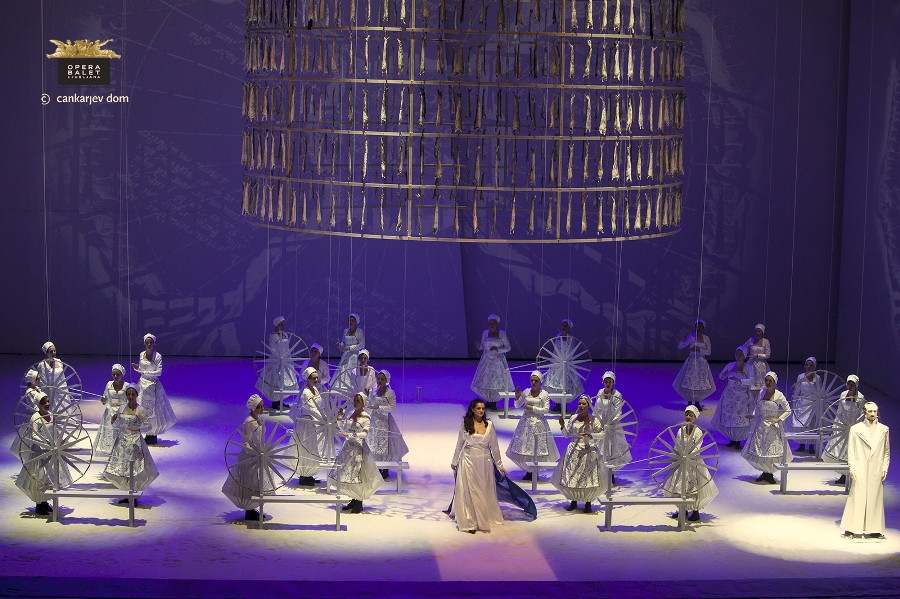
In his design of the scenery, the director used the concept of salt as an abstraction of the sea. Complementing the monumental scenography by Marko Japelj and the artistically exceptional costumography by Alan Hranitelj are the spectacular projections and the use of magical light effects, which together with the crystalline whiteness of the salt (the stage of the Gallus Hall is covered by as much as 18 tons of salt) form the stage scenery (making full use of all the available capacity of the biggest Slovenian stage). The numerous masterful performers complete the staging, which must in the words of its director »adhere to many levels of Beauty and seek its existence in the field of some other Absolute«.
Solo roles in this premiere performance have been taken by guests: Maida Hundeling (Senta), a renowned soprano, who has been performing since 2003 as a free-lance artist and is a regular guest of prestigious opera houses in Europe, USA, Canada and Japan; the Ukrainian bass baritone Andrej Maslakov (the Dutchman), member of the National Opera in Kiev and increasingly successful also on international stages; and Sarajevo-born Sonja Milenković (Maria), who lives and works in Athens and performs at well-known theatres in Europe. The audience will have the opportunity to hear also Slovenian singers and among them the internationally renowned tenor Branko Robinšak (Erik), leading performer of the Slovenian National Theatre Opera and Ballet Ljubljana; Saša Čano (Daland), member of the Ensemble of the Slovenian National Theatre Opera and Ballet Ljubljana, for whom this will be his first Wagnerian role; and Aljaž Farasin (helmsman), a young tenor who has been invited to join this production. All performances in Ljubljana (from 18 to 28 January 2013) will be in the German language with Slovenian under titles, translated by Seta Oblak.
The libretto for the opera was written by Wagner. Wagner thematically combined his personal experience of a storm on the open sea during his voyage from Riga to London with the traditional mariners' tales. He drew the content mostly from the well-known short story by Heinrich Heine From the Memoirs of Herr von Schnabelewopski and somewhat also from the Tale of the Ghost Ship by Wilhelm Hauff. Wagner explored the fate of a misfortunate captain of a ghost ship, condemned to eternal wandering and who can only be redeemed by the love of a faithful woman, as a »mystical song of people, who with a primal stroke of the human essence express a force touching the human heart«. The plot clearly incorporates the idea of salvation through the love and sacrifice of a woman; this idea became one of the driving forces of Wagner’s later work.
In conclusion, we should also mention a series of lectures entitled »Wagner's hidden worlds« to commemorate the composer's anniversary. In the lectures, which will take place from January to May in Kosovel Hall of Cankarjev dom, musicologists dr. Gregor Pompe, dr. Vlado Kotnik, dr. Jernej Weiss, dr. Mitja Reichenberg, mag. Tina Žerdin, Teja Saksida and Lovorka Nemeš Dular will present their personal views of the great musician.